China Focus: Sufferings of former serfs in old Xizang in Western accounts and their new life today

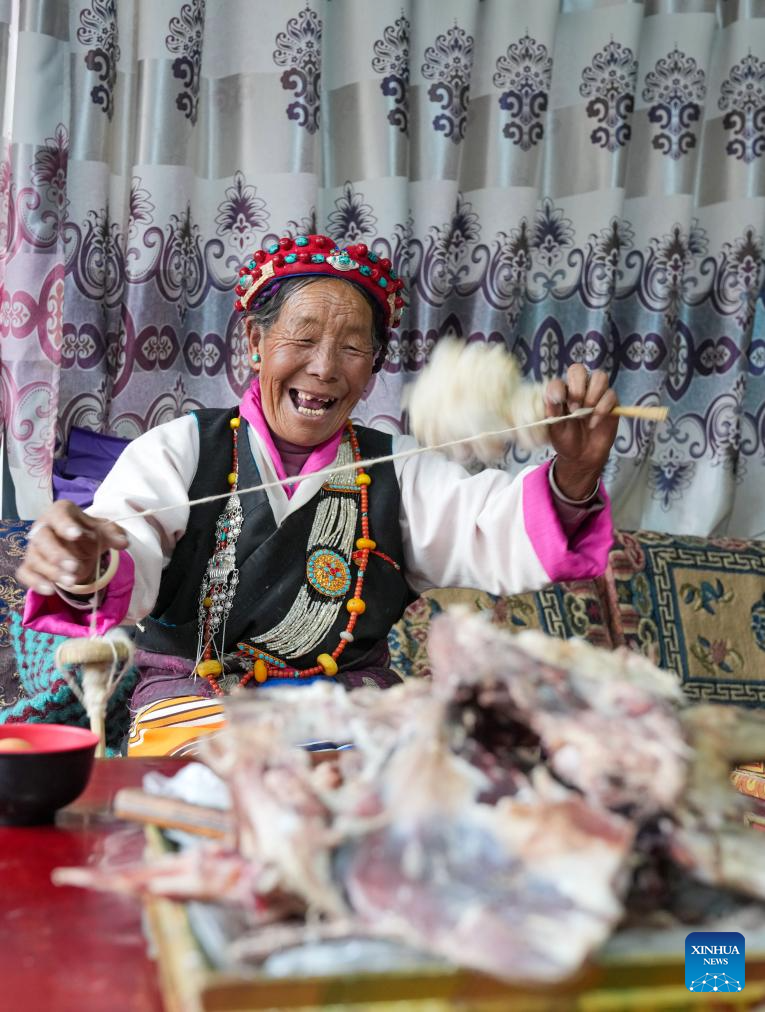
Pudron spins wool threads at home in Lumpa village of Xigaze City, southwest China's Xizang Autonomous Region, March 12, 2026. Pudron, 86, lives in Lumpa village of Xigaze City. She can never forget the old days when life was full of hardship but dignity. Since childhood, Pudron was under strict control of serf owners. Living in a low adobe house with only a small window hole, her whole family slept on the floor with only a shabby sheepskin as the quilt. Pudron had to get up before dawn to serve various duties, like driving donkeys to carry goods and fertilizing the farmland. Besides, she had to twist wool and do weaving. Thick calluses formed on her hands... Throughout the year, she had no resting day even she was hurt. Life was unendurable for her and her family, but they had no choices but lived for tiny little earnings. It was not until the democratic reform in Xizang in 1959, when millions of serfs were emancipated, that her life truly began to change for the better. Nowadays, Pudron lives with her son and daughter-in-law in a spacious and warm two-story Tibetan-style house. She is even not used to having so much butter in daily life. This is a "sweet trouble" that I never dreamed of before, she said. (Xinhua/Jigme Dorje)
LHASA, March 28 (Xinhua) -- Pudron, in her eighties, sits on a thick Tibetan sofa in her sunlit home, dressed in vibrant traditional attire, with a silver necklace gleaming around her neck.
The two-story house, fitted with a television, stereo and butter churn, stands in sharp contrast to the dwelling seven decades ago, when her family of six huddled in a shabby adobe house the size of two parking spaces, sleeping on dried grass under old goatskins.
Hailing from a village in Gyangze County, southwest China's Xizang Autonomous Region, Pudron was born in a serfs' family in 1940, tied to a manor administered by monks. She and her sister farmed, spun wool and wove from dawn to dusk, and yet after each harvest, the grains were taken as tribute.
"Sometimes we couldn't even have a bowl of warm porridge," she said, adding that the family had to rely on wild vegetables to survive.
Saturday marks Serfs' Emancipation Day. In March 1959, Xizang launched a democratic reform, and about 1 million serfs were emancipated from feudal serfdom, a turning point that Pudron and countless others remember as the moment their bondage ended.
The past 67 years have witnessed the rebirth of 1 million emancipated serfs and the advancement of human rights, the people's happy lives and the profound transformation of society, as well as ethnic unity and progress in Xizang, Gama Cedain, chairman of the regional government, said on Friday in a video speech commemorating the day.
EYEWITNESS TO HISTORY
The history that preceded such transformation was starkly documented by Western scholars who witnessed that era.
Edmund Candler, a British journalist who accompanied the British invasion of Xizang in the early 20th century, wrote that the region was "really ruled by the Lamas."
"The monks are the overlords, the peasantry their serfs," he noted in his book "The Unveiling of Lhasa."
Similar accounts were documented by the U.S. Tibetologist Melvyn Goldstein.
His book says serfs received no wages and, generally, no food from the lord on the days they worked. "Manorial estates were hereditary and, as in Europe, the main source of wealth."
Back then, the three major stakeholders -- local officials, aristocrats and higher-ranking lamas in the monasteries -- and their agents, who made up less than five percent of the population, owned almost all of the land, pastures, forests, mountains, rivers, and most of the livestock. Meanwhile, the serfs and slaves, who accounted for 95 percent of the population, had no means of production or freedom of their own.
Late Jewish journalist and writer Israel Epstein made four visits to the region between 1955 and 1985, witnessing Xizang's transformation firsthand.
In his 1983 book "Tibet Transformed," which described the region's old days as "like a descent into hell," he wrote about eight former serfs, seven men and a woman, whom he met and interviewed in 1965.
"Two had had their eyes gouged out. One had a leg tendon sundered, crippling him forever. One had his arm shot away. One had a hand chopped off and one a foot. One was deafened and disfigured and one barely escaped being ritually buried alive."
One of them was Tashi, a tanner from Lhasa's Drepung Monastery. As recorded in the book, tanners used to go from place to place to find work and earn some grain. In 1958, Tashi was returning with a bag of barley when three well-dressed men accused him of theft, without any proof.
"They tied me up, kicked me black and blue, then dragged me to the dzong (county) jail where I was chained by the ankles to a pillar. They gave me no food for days," he was quoted as saying.
He was later left in a freezing courtyard for 10 days, his leg infected and festering. Eleven years after the interview, Epstein learned Tashi's leg was still infected and painful.
Pudron was no stranger to such torture. Her father was placed in charge of watching over the lord's sea buckthorn forest. When two trees went missing, he was savagely beaten. "When my sister and I stepped forward to plead for him, we too were struck," she recalled.
REBIRTH, NEW LIFE
In 1959, the democratic reform reached Pudron's village. Her family was allocated farmland. In the following years, her family acquired livestock, including dairy cows.
"While milking the cows and watching the cattle graze in the field, I felt the sweetness of life, like fresh milk," she said.
"The inferno has ended," as Epstein noted in his book.
Now, Pudron lives with her son and daughter-in-law. In her leisure time, she likes browsing the latest news about Xizang with her smartphone. Her grandchildren, three grandsons and two granddaughters, have all built careers in various places.
Pudron herself is a municipal-level inheritor of the national intangible cultural heritage Ongkor Festival, at which participants parade around the farmland to pray for a bumper harvest.
She said in the past, even though she was young, her steps felt as heavy as lead when she worked for the lord. "Now, although I am old, each time I walk the ridges to pray for the harvest, I feel light and strong."
Figures show Xizang's gross domestic product had surged to over 303 billion yuan (about 43.8 billion U.S. dollars) in 2025 from 174 million yuan in 1959, while average life expectancy in this region has climbed from 35.5 years in the 1950s to 72.5 years today. Education in the region has achieved a historic leap, from a gross enrollment rate of less than 2 percent in old times to a nearly 100 percent enrollment rate in compulsory education currently.
Penpa Lhamo, a national political advisor and deputy director of the Xizang Academy of Social Sciences, is also a direct beneficiary of the democratic reform. Her grandmother was a serf, her mother seized the reform as an opportunity to pursue education, while Penpa Lhamo herself earned a doctorate abroad and now advises on policy for Xizang's development.
"Now that I received higher education, I will put what I have learned to good use and contribute to the development of my hometown," she said. ■

Pudron poses for a portrait in Lumpa village of Xigaze City, southwest China's Xizang Autonomous Region, March 12, 2026. Pudron, 86, lives in Lumpa village of Xigaze City. She can never forget the old days when life was full of hardship but dignity.
Since childhood, Pudron was under strict control of serf owners. Living in a low adobe house with only a small window hole, her whole family slept on the floor with only a shabby sheepskin as the quilt. Pudron had to get up before dawn to serve various duties, like driving donkeys to carry goods and fertilizing the farmland. Besides, she had to twist wool and do weaving. Thick calluses formed on her hands... Throughout the year, she had no resting day even she was hurt. Life was unendurable for her and her family, but they had no choices but lived for tiny little earnings.
It was not until the democratic reform in Xizang in 1959, when millions of serfs were emancipated, that her life truly began to change for the better. Nowadays, Pudron lives with her son and daughter-in-law in a spacious and warm two-story Tibetan-style house. She is even not used to having so much butter in daily life. This is a "sweet trouble" that I never dreamed of before, she said. (Xinhua/Jigme Dorje)

Pudron (L) chats with her family in Lumpa village of Xigaze City, southwest China's Xizang Autonomous Region, March 12, 2026. Pudron, 86, lives in Lumpa village of Xigaze City. She can never forget the old days when life was full of hardship but dignity.
Since childhood, Pudron was under strict control of serf owners. Living in a low adobe house with only a small window hole, her whole family slept on the floor with only a shabby sheepskin as the quilt. Pudron had to get up before dawn to serve various duties, like driving donkeys to carry goods and fertilizing the farmland. Besides, she had to twist wool and do weaving. Thick calluses formed on her hands... Throughout the year, she had no resting day even she was hurt. Life was unendurable for her and her family, but they had no choices but lived for tiny little earnings.
It was not until the democratic reform in Xizang in 1959, when millions of serfs were emancipated, that her life truly began to change for the better. Nowadays, Pudron lives with her son and daughter-in-law in a spacious and warm two-story Tibetan-style house. She is even not used to having so much butter in daily life. This is a "sweet trouble" that I never dreamed of before, she said. (Xinhua/Jigme Dorje)
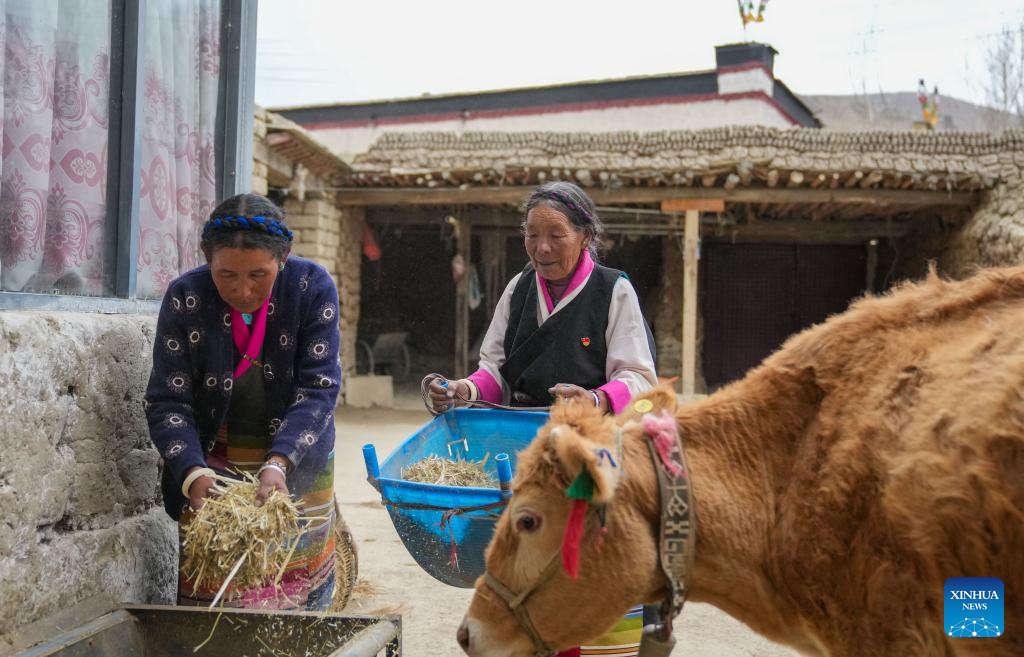
Pudron (R) and her daughter-in-law feed the cattle in Lumpa village of Xigaze City, southwest China's Xizang Autonomous Region, March 12, 2026. Pudron, 86, lives in Lumpa village of Xigaze City. She can never forget the old days when life was full of hardship but dignity.
Since childhood, Pudron was under strict control of serf owners. Living in a low adobe house with only a small window hole, her whole family slept on the floor with only a shabby sheepskin as the quilt. Pudron had to get up before dawn to serve various duties, like driving donkeys to carry goods and fertilizing the farmland. Besides, she had to twist wool and do weaving. Thick calluses formed on her hands... Throughout the year, she had no resting day even she was hurt. Life was unendurable for her and her family, but they had no choices but lived for tiny little earnings.
It was not until the democratic reform in Xizang in 1959, when millions of serfs were emancipated, that her life truly began to change for the better. Nowadays, Pudron lives with her son and daughter-in-law in a spacious and warm two-story Tibetan-style house. She is even not used to having so much butter in daily life. This is a "sweet trouble" that I never dreamed of before, she said. (Xinhua/Jigme Dorje)
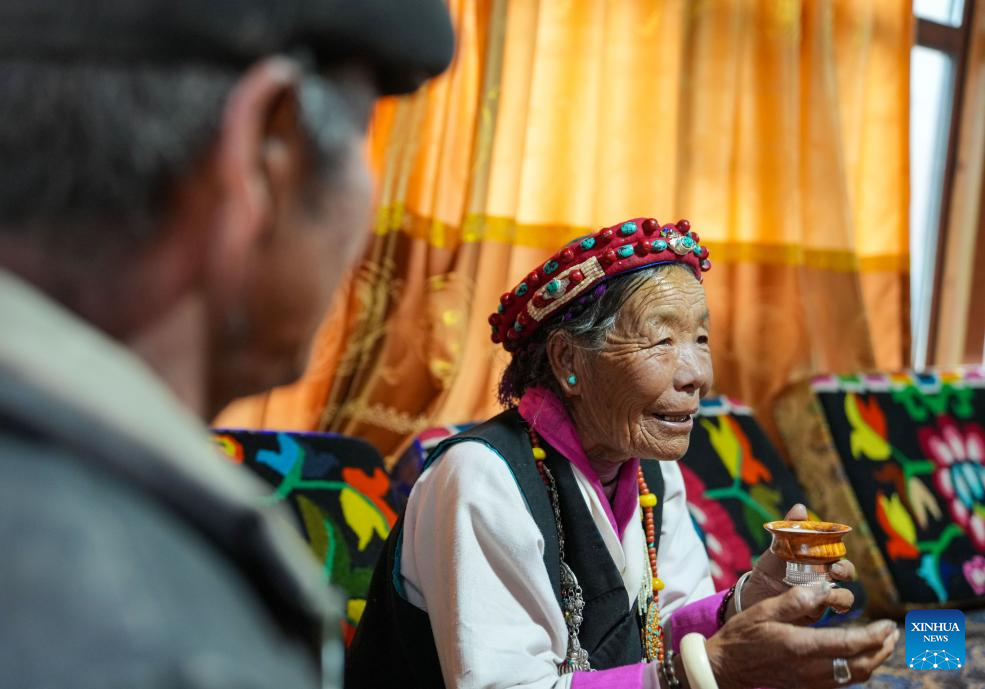
Pudron chats with her family at home in Lumpa village of Xigaze City, southwest China's Xizang Autonomous Region, March 12, 2026. Pudron, 86, lives in Lumpa village of Xigaze City. She can never forget the old days when life was full of hardship but dignity.
Since childhood, Pudron was under strict control of serf owners. Living in a low adobe house with only a small window hole, her whole family slept on the floor with only a shabby sheepskin as the quilt. Pudron had to get up before dawn to serve various duties, like driving donkeys to carry goods and fertilizing the farmland. Besides, she had to twist wool and do weaving. Thick calluses formed on her hands... Throughout the year, she had no resting day even she was hurt. Life was unendurable for her and her family, but they had no choices but lived for tiny little earnings.
It was not until the democratic reform in Xizang in 1959, when millions of serfs were emancipated, that her life truly began to change for the better. Nowadays, Pudron lives with her son and daughter-in-law in a spacious and warm two-story Tibetan-style house. She is even not used to having so much butter in daily life. This is a "sweet trouble" that I never dreamed of before, she said. (Xinhua/Jigme Dorje)

Pudron (C) poses for a photo with her son and daughter-in-law at home in Lumpa village of Xigaze City, southwest China's Xizang Autonomous Region, March 12, 2026. Pudron, 86, lives in Lumpa village of Xigaze City. She can never forget the old days when life was full of hardship but dignity.
Since childhood, Pudron was under strict control of serf owners. Living in a low adobe house with only a small window hole, her whole family slept on the floor with only a shabby sheepskin as the quilt. Pudron had to get up before dawn to serve various duties, like driving donkeys to carry goods and fertilizing the farmland. Besides, she had to twist wool and do weaving. Thick calluses formed on her hands... Throughout the year, she had no resting day even she was hurt. Life was unendurable for her and her family, but they had no choices but lived for tiny little earnings.
It was not until the democratic reform in Xizang in 1959, when millions of serfs were emancipated, that her life truly began to change for the better. Nowadays, Pudron lives with her son and daughter-in-law in a spacious and warm two-story Tibetan-style house. She is even not used to having so much butter in daily life. This is a "sweet trouble" that I never dreamed of before, she said. (Xinhua/Jigme Dorje)


